
Flying With Type 1 Diabetes: What I Actually Do at Airport Security
Airport security was one of the things I worried about most before my first international trip with Type 1 diabetes.
I wasn’t just thinking about taking my shoes off, getting my bags through security and finding my gate.
I was thinking about insulin.
My insulin pump.
My CGM.
Extra sensors.
Cooling my insulin.
What if something got lost?
What if my insulin got too warm and didn’t work as well?
What if my pump failed?
What if my CGM stopped communicating?
And then there were the scanners.
Could my devices go through them?
Could airport security damage something I depended on to manage my diabetes?
Before that first trip, these questions felt like a much bigger deal than they do to me today.
After going through airport security in multiple countries, one of the biggest things I’ve learned is this:
Airport security with diabetes is usually much easier than I imagined it would be.
That doesn’t mean you shouldn’t prepare.
It means knowing what to expect can take a lot of the fear out of it.
What I Do Before I Even Reach the Scanner
When I get to airport security, I tell the security officer that I have Type 1 diabetes and that I’m wearing an insulin pump and a continuous glucose monitor.
I personally request alternative screening rather than taking my pump through the full-body scanner.
This is something airport security deals with more often than you might think.
In my experience with TSA in the United States, the officers have been well-trained and familiar with diabetes devices. They bring me around the scanner and perform a pat-down instead.
I also tell them exactly where my devices are located.
That makes everything easier.
There is no reason, in my experience, to make the officer discover a pump clipped to your hip or a CGM attached to your body during the screening. I tell them what I’m wearing and where it is before we start.
TSA itself tells passengers with an insulin pump, glucose monitor, or other medical device attached to their body to inform the officer about the device and its location before screening begins. TSA also says passengers can request a pat-down instead of screening by technology.
What the Pat-Down Is Actually Like
This was something I was nervous about before experiencing it.
In reality?
It’s pretty uneventful.
The officer performs a physical pat-down to make sure you aren’t carrying anything you shouldn’t be.
In my experience, the whole process generally takes around 10 minutes from start to finish.
I tell the officer where my pump, infusion site and CGM are located.
I’ve also been asked to rub my hands over my pump, infusion site and CGM. My hands are then swabbed and tested.
That can sound intimidating if you’ve never experienced it, but it has become completely routine for me.
TSA says that an insulin pump or glucose monitor attached to the body may receive additional screening and that a passenger may be asked to perform a self-pat-down of the device followed by testing of their hands for traces of explosives.
And if you’re concerned about who performs the pat-down, TSA says pat-downs are conducted by an officer of the same sex, and you can request private screening.
For me, there really isn’t a funny or embarrassing story here.
It’s quick.
It’s professional.
It’s business.
And then I move on.
What Happens to My Diabetes Bag
I keep my diabetes supplies in my carry-on.
Most of those supplies stay in the bag when it goes through screening, although I personally separate anything I don’t want going through the screening equipment based on the instructions for my particular devices.
My bags have been pulled aside for secondary screening multiple times.
That doesn’t necessarily mean something is wrong.
An officer may open the bag, look through it, perform additional testing, or ask what something is.
In my experience, they’ve usually been pretty quick about it.
I’ve never been prevented from traveling because I was carrying my insulin or diabetes supplies.
TSA permits diabetes-related medications, equipment, and supplies through security after screening. Medically necessary liquids can also exceed the normal 3.4-ounce limit in reasonable quantities, although TSA says you should declare them and expect that they may receive additional screening.
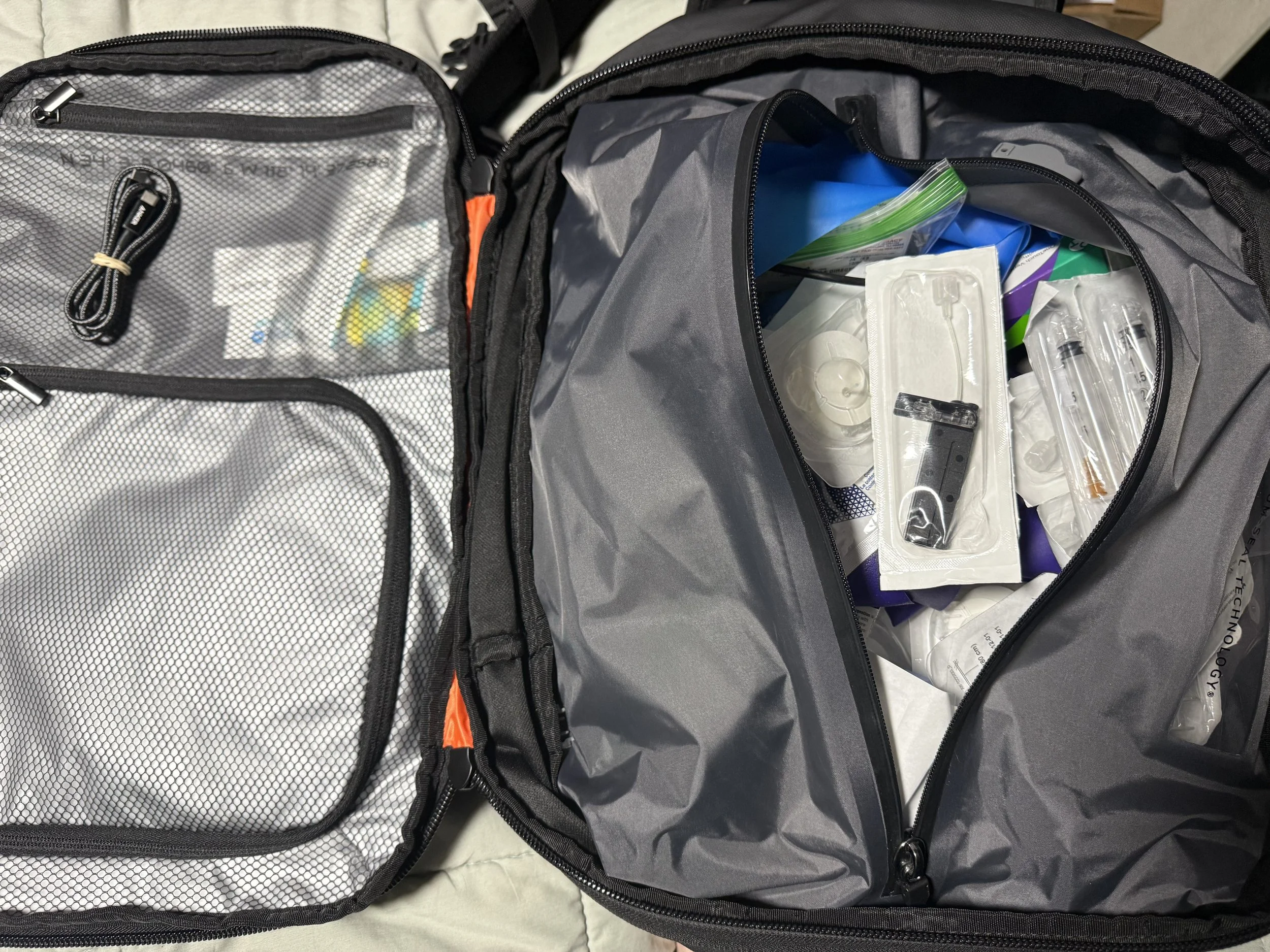
My diabetes supply bag packed for travel, keeping my essential diabetes supplies with me in my carry-on.
The One Thing I Prepare Before I Reach the Bins
One little thing makes the process easier for me:
I don’t wait until I’m standing in front of the security officer to start digging through my luggage.
Before I reach the area where everyone puts their belongings into bins, I already have anything I want manually inspected ready to show the officer.
On my earlier trips, that included my extra CGM sensors because I was avoiding putting them through the baggage scanner.
I’d tell the officer what they were and that I wanted them manually screened. An officer could inspect or swab them and then return them to me on the other side.
The important lesson here isn’t that your CGM supplies necessarily need the same treatment.
It’s this:
Know the screening instructions for your specific devices before you get to the airport.
And have anything requiring special handling ready before you reach the front of the line.
It saves time for you.
It saves time for security.
And, frankly, it’s courteous to everyone standing behind you.
Not Every Pump and CGM Has the Same Airport Security Rules
This is extremely important.
I use my own specific pump and CGM system, but someone else might use an Omnipod or Medtronic pump. Their CGM might be a Dexcom, FreeStyle Libre, Medtronic system, or something else entirely.
Do not assume the airport-security instructions for my devices are the instructions for yours.
They aren’t necessarily.
For example, current U.S. Dexcom guidance says the Dexcom G7 can be worn through walk-through metal detectors and Advanced Imaging Technology body scanners, and Dexcom says G7 is safe through luggage screening.
Tandem, on the other hand, says its t:slim insulin pump should not be exposed to the X-ray screening used for carry-on or checked luggage and should not be exposed to newer full-body scanners.
Medtronic’s guidance for its MiniMed 780G says not to send the pump or transmitter through an X-ray baggage scanner and says system components should be removed before full-body scanning; it recommends requesting an alternative screening method if necessary.
Omnipod guidance can also depend on the particular system and market. For example, current Omnipod 5 documentation I reviewed warns against AIT body scanners and X-ray baggage scanners and recommends alternative screening or visual inspection.
FreeStyle Libre users should likewise check the instructions for their exact Libre model and country rather than assuming another CGM’s rules apply to theirs.
Manufacturers update products and guidance.
Before every trip, check the current instructions for the exact pump and CGM you use.
That is much safer than relying on what another traveler—including me—does with a different device.
What About Disconnecting Your Pump?
Personally, I keep my pump connected during the alternative screening process.
If there were a situation where I needed to disconnect it briefly and the instructions for my device allowed that approach, I personally wouldn’t consider being disconnected for a couple of minutes a major issue.
But that’s my personal experience, not an instruction for someone else to disconnect their insulin pump.
Different pumps work differently, and your individual insulin needs matter.
Follow the instructions for your specific device and whatever plan you’ve established with your healthcare team.
The Mountain of Paperwork I Used to Carry
On my first international trip, I was prepared for practically everything.
Maybe a little too prepared.
I carried a diabetes identification card.
I carried a doctor’s note explaining my diabetes and medical supplies.
But I didn’t stop there.
I had printed hotel confirmations.
Train information.
Bus information.
Attraction reservations.
Invoices.
Basically, if I could print proof of something related to that trip, I probably had it with me.
I don’t do that anymore.
Today, I still like traveling with my diabetes identification information and a doctor’s travel note, but most of my regular travel reservations stay digital.
I’ve personally never had airport security ask to see my diabetes documentation.
I still like having it.
For me, it’s one of those things that makes traveling less stressful because if a question ever does come up, I have something that clearly explains the situation.
And when I’m traveling somewhere that doesn’t primarily use English, having diabetes travel information available in the local language can make communication much easier.
That’s one of the reasons I’ve made English diabetes identification and travel-document resources available through Glucose Getaways, with country-specific versions planned as well.
Google Translate Has Become One of My Airport Tools
Airport security outside the United States can be different.
Not necessarily worse.
Just different.
And sometimes the biggest obstacle isn’t diabetes.
It’s language.
When I was traveling through Italy and Portugal on my first international trip, I had already prepared messages in Google Translate explaining that I had diabetes and was wearing medical devices.
If an officer didn’t immediately understand what I was trying to explain, I could show them the translated message and point out my pump.
That usually made things much easier.
After you’ve done this a few times, you also get better at knowing what you need to say.
By the third security checkpoint, something that felt overwhelming the first time starts becoming:
Okay. I know how to do this.
The Best Airport Experience I’ve Had Was Japan
Japan stands out to me.
The process itself wasn’t necessarily the shortest.
Actually, there were a lot of lines.
There were multiple checkpoints, scanners and people I needed to speak with.
But everything moved efficiently, and the people I interacted with were incredibly friendly and helpful.
Even with thousands of travelers moving through the airport, my experience still felt surprisingly personal.
Japan also taught me an important lesson about international travel:
An easy airport experience doesn’t necessarily mean there was less preparation beforehand.
Japan has strict rules about what can be brought into the country, including rules affecting some medications, and travelers may have entry procedures and forms to complete before arriving.
I had done my preparation.
Once I was there, I found the actual experience organized, efficient, and incredibly helpful.
Iceland was another relatively comfortable airport experience for me. The airport was smaller, and the people I dealt with were nice.
Italy and Portugal felt a little more complicated on my first trip, although I think some of that was simply because they were my first international airport experiences.
Nobody was mean.
It was more:
No frills. All business.
And there’s nothing wrong with that.
Then Iceland Thought My Bag Had Explosives
There is one airport-security story I can laugh about now.
When I was leaving Iceland, my bag triggered additional screening for what appeared to be explosive residue.
Not exactly what you want to hear at airport security.
I was sent for secondary screening, and there was a lot of checking and discussion while we tried to figure out what had caused it.
Eventually, the likely explanation became pretty obvious.
I had spent the trip hiking around volcanic areas and visiting geothermal lagoons.
My belongings had been exposed to those environments, and we believed residue from the volcanic/geothermal areas, potentially sulfur or other material, was what had triggered the screening.
Once everything was checked and cleared, I was able to continue.
So if you’re visiting Iceland and spending your vacation around volcanoes, geothermal areas, and lagoons, don’t automatically panic if something gets flagged.
It may simply mean security needs to take a closer look.
And yes, I appreciate the irony that my diabetes supplies weren’t what caused the memorable security problem.
It was Iceland itself.

Sunrise at the Blue Lagoon in Iceland, one of several geothermal areas I visited during the trip.
Security Screening, Passport Control and Customs Are Different Things
This confused me on my first international trip, so it’s worth mentioning.
Airport security isn’t necessarily the same thing as passport control or customs.
Security screening is where you and your belongings are checked before entering the secure area of an airport.
Passport control or immigration deals with your entry into a country. Depending on the destination and circumstances, you may be asked why you’re visiting, how long you’re staying, where you’re staying, and other questions about your trip.
Customs deals with what you’re bringing into a country and whether you need to declare anything.
Understanding that these are separate processes would have saved me some confusion on my first international trip.
What I Wish I Had Known Before My First Flight
More than anything?
I wish I had known how manageable it was going to be.
I spent so much time worrying about airport security before that first international trip.
And I’m not saying nothing can ever go wrong.
Your bag might get pulled aside.
An officer might ask questions.
You may need additional screening.
You might have to explain your devices.
International procedures can differ.
But I’ve also found people to be much more accommodating than I expected.
Today, I prepare my supplies, check the current instructions for my devices, have my documentation available, communicate with the security officers and give myself enough time.
Then I go through security.
What once felt like this enormous barrier between me and international travel has become another normal part of traveling with Type 1 diabetes.
And that’s probably the biggest thing I’d tell someone who’s standing where I once was:
Don’t let the airport security line become scarier in your imagination than it needs to be.
Prepare.
Know your equipment.
Speak up about what you need.
Give yourself extra time.
And once you’re through?
Go find your gate.
You have somewhere to go.
Traveling With Diabetes?
Make communication a little easier while you’re away. Download my free English Diabetes Identification Card, designed to keep important diabetes and emergency information with you while traveling.